Published by the BLACK BUYCOTT™ MOVEMENT Research Department Source: Google Trends, United States, June 2026
Every month, the Research Department pulls raw public search data and looks for patterns in how people are searching for Black-owned businesses across the country. This is not opinion. It is not a survey. It is what millions of people typed into a search bar with nobody watching. And this month, the data told a story most people are not paying attention to yet.
Before we get into the numbers, let’s clear something up, because most people have never heard this word and the ones who have usually get it wrong.
A boycott is when a group of people say no to something. They stop buying from a store, a brand, or a company, usually to protest something that company did.
A buycott is the opposite. It is when a group of people say yes to something else instead. Instead of just walking away from one business, they walk toward another one on purpose. Every dollar still gets spent. It just gets spent somewhere new.
Here is the easiest way to explain it to a five year old. Imagine you and your friend both have a red toy and a blue toy. If you decide to stop playing with the red toy, that is a boycott. If you decide to start playing with the blue toy instead, on purpose, every single day, that is a buycott. You are not just walking away. You are walking somewhere.
That is the whole idea. Stop boycotting. Start BUYCOTTING. The word is spelled B-U-Y-C-O-T-T on purpose, because the “buy” is the entire point. It is not a withdrawal of money from the economy. It is a redirection of money inside it. This is what is being called the “Black Wealth Transfer.”
With that out of the way, here is what the search data actually shows.
Search interest for Black-owned businesses in general cooled off significantly after the middle of June, dropping from a high near 100 down into the mid twenties by the end of the month. That is a normal pattern. Broad, general searches spike around a cultural moment and then fade.
But one very specific category did not fade. It grew. Searches for Black owned nail salons, Black nail salons near me, and Black owned nail salons near me all registered as Breakout terms in the same week, meaning search volume for those exact phrases grew far faster than Google Trends can even assign a normal percentage to. Six of the top eight rising search terms in the entire dataset were nail salon variations.
This tells the Research Department something simple. People are not just looking for a general idea anymore. They are looking for a specific chair to sit in, on a specific Saturday, in a specific neighborhood. That is what real economic behavior looks like. It is not a hashtag. It is somebody looking up an address.
Juneteenth 2026 produced the kind of spike you would expect. But something more important happened right after it. The generic phrase “Black business” collapsed back down once the holiday passed. The more specific phrase “Black-owned business” did not collapse. It settled at a new baseline nearly three times higher than where it started the month.
In plain terms, the holiday did not create a one day spike that disappeared. It created new searchers who kept using the more specific, more intentional phrase long after Juneteenth was over. That is not a moment. That is a habit forming in real time, and it lines up with everything the movement has said from day one about Black Wealth Transfer being a long game, not a single news cycle.
A newer pattern showed up this round that the Research Department had not tracked before. Searches asking whether specific consumer brands are Black owned started appearing as Breakout terms. People want to verify before they buy. They are not just looking for a category anymore. They are checking receipts.
This matters because it confirms the entire reason a verification layer exists in the first place. Standing on Business, 10 Toes In, is not just a phrase people say. It describes exactly what this new search behavior looks like from the outside. Somebody who is standing on business does not guess. They check. They confirm. Then they spend.
City level data showed continued strong interest in Chicago, Atlanta, and Detroit, alongside a noticeable cluster of activity in Denver, Charlotte, Oakland, and Phoenix, cities that were not part of the original national conversation around this movement but are now showing up in the data on their own. Local search behavior is often the earliest signal of where a community is already organizing itself before anyone officially announces anything. We on code does not mean everyone got a memo. It means people already move the same way without needing one.
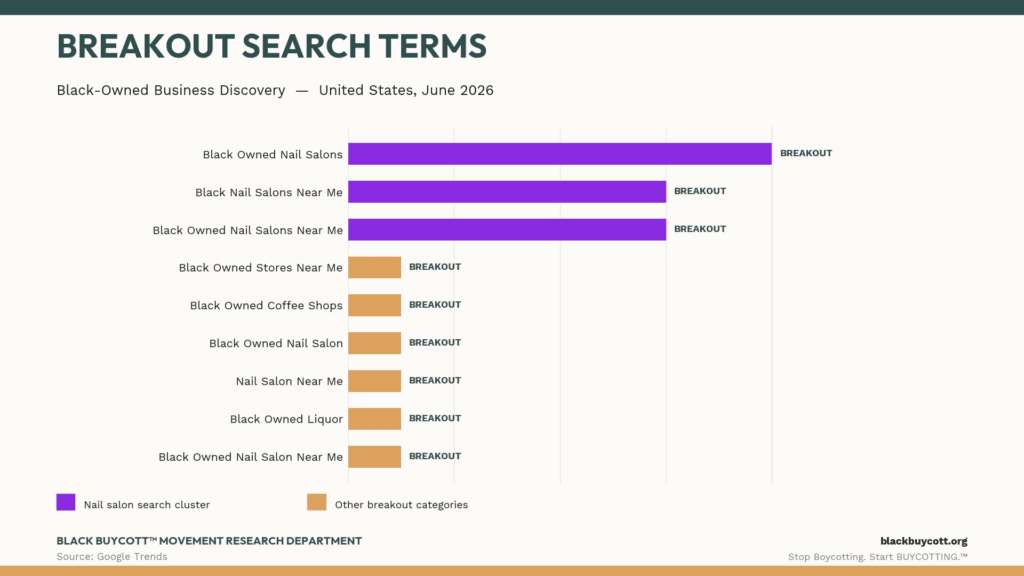
The chart above shows the nine highest performing Breakout search terms from this reporting period, sourced directly from Google Trends. The purple bars represent the nail salon search cluster described above. The gold bars represent the remaining Breakout categories, including coffee shops, general store locators, and liquor retailers.
Search data does not lie and it does not have an agenda. It simply reflects what people are already doing before they tell anyone they are doing it. Publishing it openly, every month, sourced and unedited, is how the movement stays honest with itself and with the community it serves. If the data ever showed interest cooling for good, that would get published too. This month, it did not.
If this kind of research matters to you, one of the simplest ways to support the work behind it is to grab something from the store. Every purchase helps fund the next round of data collection, the next city added to the directory, and the next report published for free, for anyone, with no paywall. Visit blackbuycott.org/shop/ and pick up a piece of the movement. Stand on business. Ten toes in.